
10 KiB




Pi is a minimal terminal coding harness. Adapt pi to your workflows, not the other way around, without having to fork and modify pi internals. Extend it with TypeScript Extensions, Skills, Prompt Templates, and Themes. Put your extensions, skills, prompt templates, and themes in Pi Packages and share them with others via npm or git.
Pi ships with powerful defaults but skips features like sub agents and plan mode. Instead, you can ask pi to build what you want or install a third party pi package that matches your workflow.
Pi runs in four modes: interactive, print or JSON, RPC for process integration, and an SDK for embedding in your own apps. See clawdbot/clawdbot for a real-world SDK integration.
Table of Contents
- Quick Start
- Providers & Models
- Interactive Mode
- Sessions
- Configuration
- Customization
- CLI Reference
- Programmatic Usage
- Philosophy
Quick Start
npm install -g @mariozechner/pi-coding-agent
Authenticate with an API key:
export ANTHROPIC_API_KEY=sk-ant-...
pi
Or use your existing subscription:
pi
/login  # Then select provider
Then just talk to pi. Ask it to work on your codebase, run commands, or perform tasks for you.
Platform notes: Windows | Terminal setup | Shell aliases
Providers & Models
For each built-in provider, pi maintains a list of tool-capable models, updated with every release. Authenticate via subscription (/login) or API key, then select any model from that provider via /model (or Ctrl+L).
Subscriptions:
- Anthropic Claude Pro/Max
- OpenAI ChatGPT Plus/Pro (Codex)
- GitHub Copilot
- Google Gemini CLI
- Google Antigravity
API keys:
- Anthropic
- OpenAI
- Azure OpenAI
- Google Gemini
- Google Vertex
- Amazon Bedrock
- Mistral
- Groq
- Cerebras
- xAI
- OpenRouter
- Vercel AI Gateway
- ZAI
- OpenCode Zen
- MiniMax
See docs/providers.md for detailed setup instructions.
Custom providers & models: Add providers via ~/.pi/agent/models.json if they speak a supported API (OpenAI, Anthropic, Google). For custom APIs or OAuth, use extensions. See docs/models.md and docs/custom-provider.md.
Interactive Mode
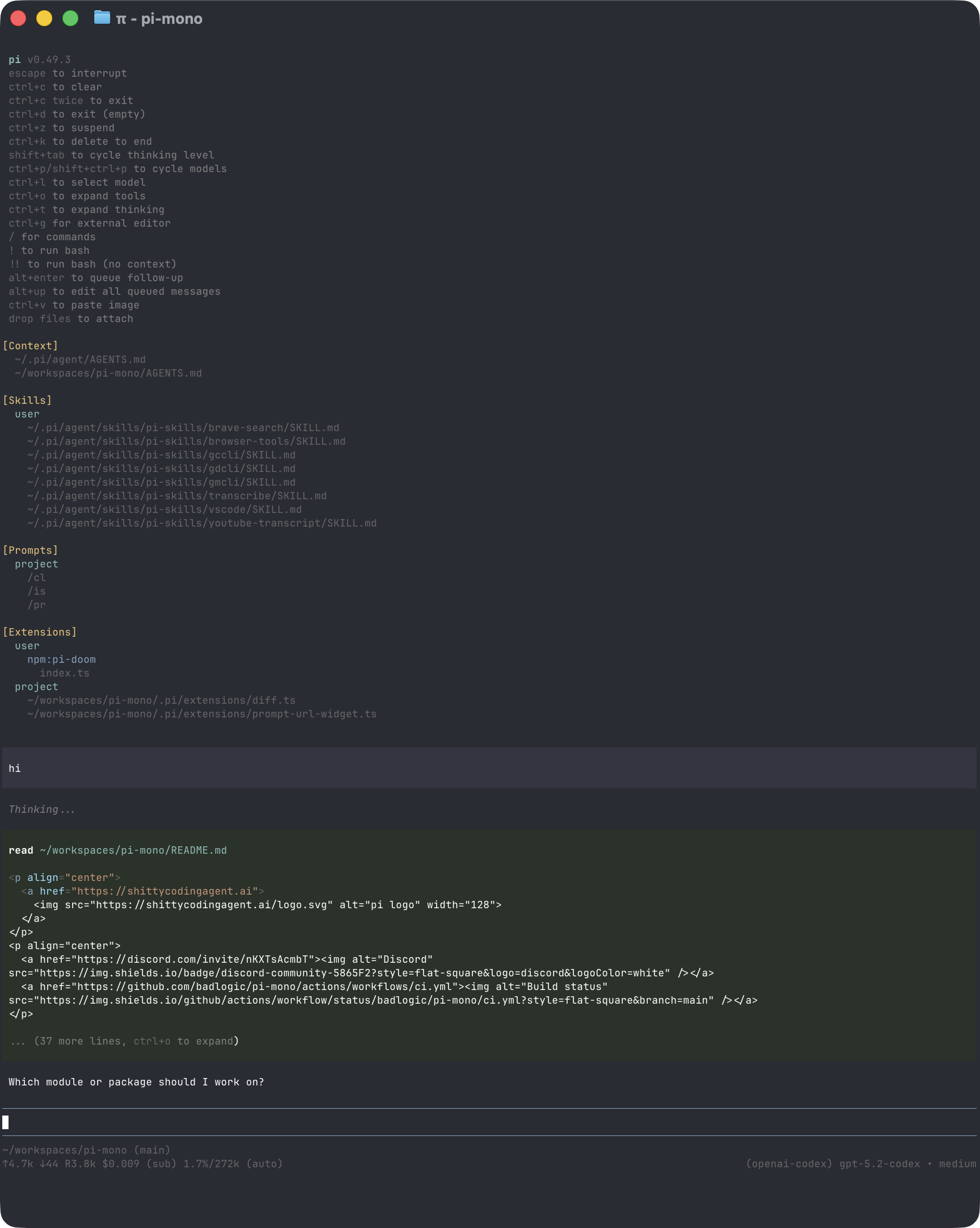
The interface from top to bottom:
- Header - On startup, shows shortcuts (
/hotkeysfor all), loaded AGENTS.md files, prompt templates, skills, and extensions - Messages - Your messages, assistant responses, tool calls and results, custom UI from extensions
- Editor - Where you type
- Footer - Working directory, token usage, cost, current model
The editor can be temporarily replaced by other UI, like built-in /settings or custom UI from extensions (e.g., a Q&A tool that lets the user answer model questions in a structured format). Extensions can also replace the editor, add widgets above/below it, a status line, custom footer, or overlays.
Editor
| Feature | How |
|---|---|
| File reference | Type @ to fuzzy-search project files |
| Path completion | Tab to complete paths |
| Multi-line | Shift+Enter (or Ctrl+Enter on Windows Terminal) |
| Images | Ctrl+V to paste, or drag onto terminal |
| Bash commands | Prefix with ! (e.g., !git status) |
Commands
Type / in the editor to trigger commands. Extensions can register custom commands, skills are available as /skill:name, and prompt templates expand via /templatename.
| Command | Description |
|---|---|
/login, /logout |
OAuth authentication |
/model |
Switch models |
/settings |
Thinking level, theme, message delivery |
/resume, /new |
Session management |
/tree, /fork |
Navigate and branch session history |
/compact |
Manually compact context |
/export, /share |
Export to HTML or GitHub gist |
/reload |
Reload extensions, skills, prompts, themes |
/hotkeys |
Show all keyboard shortcuts |
See Customization for skills, prompt templates, and extensions.
Keyboard Shortcuts
See /hotkeys for the full list. Customize via ~/.pi/agent/keybindings.json. See docs/keybindings.md.
Highlights:
| Key | Action |
|---|---|
| Ctrl+P | Cycle models |
| Ctrl+L | Open model selector |
| Shift+Tab | Cycle thinking level |
| Ctrl+O | Toggle tool output |
| Ctrl+T | Toggle thinking blocks |
| Escape | Cancel/abort |
Sessions
Sessions auto-save to ~/.pi/agent/sessions/ with tree structure for branching.
pi -c              # Continue most recent
pi -r              # Browse and select
pi --no-session    # Ephemeral mode
Branching: Use /tree to navigate history in-place, or /fork to create a new session from any point.
Compaction: Long sessions can exhaust context. Use /compact manually or enable auto-compaction in /settings.
See docs/sessions.md for file format and branching details.
Configuration
Context Files
Pi loads AGENTS.md files at startup (global ~/.pi/agent/AGENTS.md, parent directories, current directory). Use for project instructions, conventions, common commands.
System Prompt
Replace the default system prompt with .pi/SYSTEM.md (project) or ~/.pi/agent/SYSTEM.md (global). Append without replacing via APPEND_SYSTEM.md.
Custom Models
Add Ollama, vLLM, LM Studio, or proxy endpoints via ~/.pi/agent/models.json:
{
  "providers": {
    "ollama": {
      "baseUrl": "http://localhost:11434/v1",
      "api": "openai-completions",
      "models": [{ "id": "llama-3.1-8b", "name": "Llama 3.1 8B", ... }]
    }
  }
}
See docs/models.md for full schema and examples.
Settings
Global settings in ~/.pi/agent/settings.json, project overrides in .pi/settings.json.
See docs/settings.md for all options.
Customization
Themes
Built-in: dark, light. Create custom themes in ~/.pi/agent/themes/*.json with live reload.
See docs/themes.md.
Prompt Templates
Reusable prompts as Markdown files in ~/.pi/agent/prompts/ or .pi/prompts/. Type /name to expand.
Skills
On-demand capability packages following the Agent Skills standard. Place in ~/.pi/agent/skills/ or .pi/skills/. Invoke via /skill:name or let the agent load them automatically.
See docs/skills.md.
Extensions
TypeScript modules for custom tools, commands, event interception, and UI.
export default function (pi: ExtensionAPI) {
  pi.registerTool({ name: "deploy", ... });
  pi.registerCommand("stats", { ... });
  pi.on("tool_call", async (event, ctx) => { ... });
}
Place in ~/.pi/agent/extensions/ or .pi/extensions/.
See docs/extensions.md and examples/extensions/.
Pi Packages
Bundle and share extensions, skills, prompts, and themes via npm or git:
pi install npm:@foo/pi-tools
pi install git:github.com/user/repo
pi list
pi update
See docs/packages.md.
CLI Reference
pi [options] [@files...] [messages...]
Modes
| Flag | Description |
|---|---|
| (default) | Interactive mode |
-p, --print |
Print response and exit |
--mode json |
JSON event stream |
--mode rpc |
RPC mode for process integration |
Common Options
| Option | Description |
|---|---|
--provider, --model |
Select provider and model |
--thinking <level> |
off, minimal, low, medium, high |
--models <patterns> |
Patterns for Ctrl+P cycling |
-c, --continue |
Continue most recent session |
-r, --resume |
Browse and select session |
--tools <list> |
Limit tools (default: read,bash,edit,write) |
File Arguments
pi @prompt.md "Answer this"
pi @screenshot.png "What's in this image?"
See pi --help for all options.
Programmatic Usage
SDK
import { AuthStorage, createAgentSession, ModelRegistry, SessionManager } from "@mariozechner/pi-coding-agent";

const { session } = await createAgentSession({
  sessionManager: SessionManager.inMemory(),
  authStorage: new AuthStorage(),
  modelRegistry: new ModelRegistry(authStorage),
});

await session.prompt("What files are in the current directory?");
See docs/sdk.md and examples/sdk/.
RPC Mode
pi --mode rpc --no-session
See docs/rpc.md for the protocol.
HTML Export
pi --export session.jsonl output.html
Philosophy
No MCP. Build CLI tools with READMEs (see Skills). Why?
No sub-agents. Spawn pi instances via tmux, or build your own with Extensions.
No permission popups. Run in a container or build your own confirmation flow.
No plan mode. Write plans to files, start fresh for implementation.
Read the blog post for the full rationale.
Development
See docs/development.md for forking, rebranding, and debugging.
License
MIT
See Also
- @mariozechner/pi-ai: Core LLM toolkit
- @mariozechner/pi-agent: Agent framework
- @mariozechner/pi-tui: Terminal UI components